
Are AI Robots Dangerous? The Real Answer
- Or Alkalay
- May 31
- 6 min read

A warehouse robot clips a shelf, a delivery bot blocks a sidewalk, a humanoid posts a weird demo online, and suddenly the question is everywhere: are ai robots dangerous? It is the right question, but it usually gets asked in the wrong way. Not all robots carry the same level of risk, not all AI behaves the same way, and not every dramatic headline tells you what actually matters when a machine enters the real world.
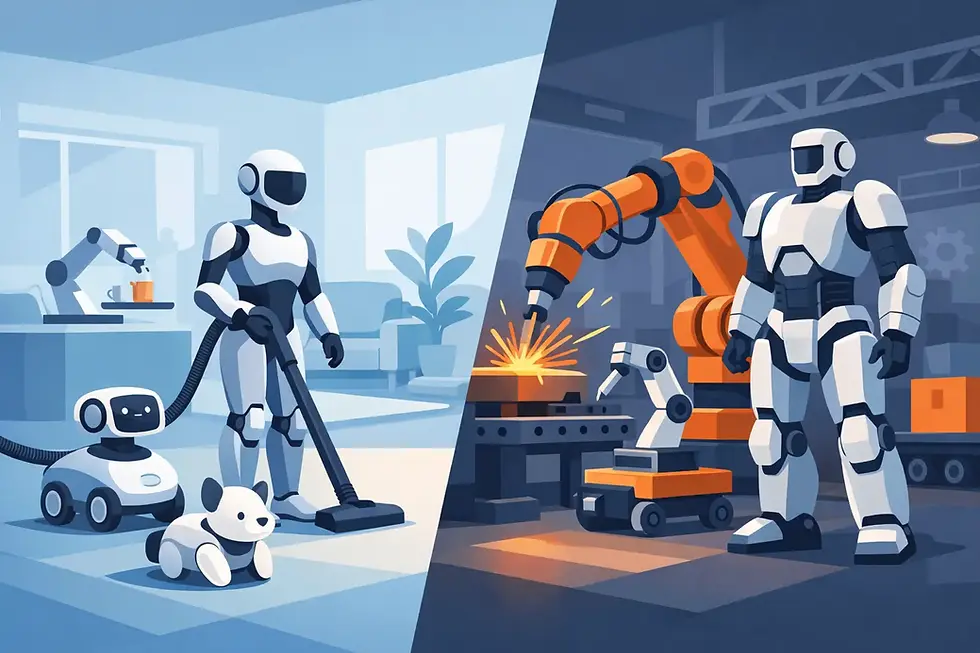
The more useful question is this: dangerous to whom, in what setting, and because of what failure? A robotic vacuum and an autonomous security platform are both robots. A companion bot for the living room and an industrial arm on a factory floor are both powered by software. But the risk profile is completely different. That is where the real conversation starts.
Are AI robots dangerous in real life?
Sometimes, yes. Usually, not in the movie-villain way people imagine.
The biggest real-world dangers come from three sources: physical harm, bad decision-making, and misuse by humans. A robot can be dangerous because it is heavy, fast, sharp, mobile, connected, or trusted too much. Add AI to that mix, and the machine may also make unpredictable choices, misread its environment, or respond in ways that look smart in a demo but break down in messy reality.
That does not mean the entire category is unsafe. It means robotics is now moving out of lab conditions and into homes, sidewalks, hospitals, warehouses, and public spaces. Once that happens, safety stops being a marketing line and becomes the product.
An autonomous quadruped patrolling rough terrain has one kind of risk. A humanoid helping with lifting tasks has another. A robotic pet with conversational AI might never physically injure someone, but it can still create privacy concerns, emotional dependence, or false trust. The danger is not one thing. It is a stack of trade-offs.
The biggest risks people should actually care about
Physical safety is still the first layer. If a robot has motors, weight, grip strength, wheels, or legs, it can collide with people or objects. This is especially true for humanoids and mobile robots operating near children, pets, or untrained users. A flashy demo can make movement look smooth and magical. Real life includes wet floors, bad lighting, weak Wi-Fi, clutter, edge cases, and people doing unexpected things.
Then there is AI judgment. A robot does not need evil intent to be dangerous. It only needs to misunderstand what it sees. Vision systems can fail. Object recognition can miss context. Voice models can mishear commands. Planning systems can choose actions that technically fit a goal but make no sense for the environment. If a robot mistakes a fragile object for a stable handle, or a person’s gesture for permission, the result can be expensive or harmful.
Cybersecurity is another major issue, and it gets less attention than it should. A connected robot is not just hardware. It is software, sensors, cloud services, updates, accounts, permissions, microphones, cameras, and often location data. If that stack is weak, the risk is not only that the robot fails. The risk is that someone else accesses it, manipulates it, or extracts data from it.
Privacy matters even for cute machines. AI companions, home assistants, and smart monitoring robots are designed to be present. That is their value. But presence means data collection. The more helpful a robot becomes, the more it tends to observe, remember, and personalize. That creates convenience, but also exposure. A household robot that maps your home, hears your routines, and recognizes faces can be incredibly useful. It can also become a surveillance device if handled carelessly.
Why some robots are riskier than others
A simple rule helps: the more autonomy, mobility, strength, and access a robot has, the higher the stakes.
A robotic toy with limited movement and no internet connection is one thing. A humanoid with articulated hands, active balance, cloud-connected AI, and the freedom to move through your space is another level entirely. This does not make humanoids bad. It just means they demand better guardrails.
Industrial robots have long been dangerous in the most obvious sense, which is why factories use cages, sensors, emergency stops, and strict procedures. Consumer robotics is trickier because the environments are open and unpredictable. Homes are chaotic. Public settings are chaotic. People assume friendly machines are safe machines, and that assumption can be wrong.
Companion robots introduce a different category of risk: social manipulation and overtrust. If a machine feels emotionally responsive, people may share more, rely on it more, and question it less. That can be powerful in elder care, education, and support scenarios. It can also blur the line between tool and relationship in ways the market is still figuring out.
Are humanoid robots more dangerous?
In some ways, yes, because they are built to operate where humans operate.
Humanoid robots are exciting precisely because they can fit into a human-designed world. They can walk through doors, reach shelves, carry bins, and potentially assist in homes and workplaces without requiring everything around them to be rebuilt. That is the dream. It is also the challenge.
A machine with humanlike form factor creates human expectations. People assume it understands more than it does. They expect intuitive behavior, spatial awareness, and natural safety cues. But even advanced systems can still struggle with balance, edge cases, object handling, and social context. The closer a robot gets to our shape, the more people project competence onto it.
This is why safety for humanoids cannot be treated as a side feature. It has to include motion constraints, force limits, fail-safe behavior, remote shutdown options, strong testing, and clear boundaries around what the robot should not attempt yet. The best robotics companies understand this. The race is not just about capability. It is about trustworthy capability.
Hype makes the danger question harder
Some fear around AI robots is overblown. Some of it is completely justified. The problem is that hype mixes both together.
On one side, you get apocalyptic claims that every smart machine is one software update away from rebellion. That sells attention, but it does not help buyers, builders, or curious observers think clearly. On the other side, you get polished promotional content that implies near-human reliability when the product is still very early. That is not helpful either.
The reality lives in the middle. Most robots today are narrow systems. They are not conscious. They are not plotting. But they can still fail in costly, dangerous, or deeply awkward ways. A weakly supervised robot with too much access can absolutely create problems without having anything close to general intelligence.
This is why robotics needs honest framing. Show the demos, yes. Celebrate the breakthroughs, absolutely. But also ask what happens when the battery runs low, the sensors get confused, the model is wrong, or the user behaves unpredictably. That is where trust is built.
What makes AI robots safer?
Good robotics design starts with limits, not bravado. Safe robots are usually the ones built with layered control systems, conservative behavior around humans, and clear fallback modes when confidence drops. If the robot is unsure, it should slow down, stop, or ask for input. That sounds less futuristic than fully autonomous everything, but it is how real products earn their place.
Testing matters more than theatrics. So do boring things like compliance standards, maintenance schedules, software updates, sensor redundancy, and user education. A company that takes safety seriously is usually willing to talk about constraints. It does not present the robot as magic. It presents it as a machine with specific strengths and clearly managed limits.
Human oversight still matters too. For the foreseeable future, many of the best robot deployments will be supervised, semi-autonomous, or limited to tightly defined tasks. That is not a disappointment. That is how great technology scales responsibly.
For buyers and enthusiasts, the smartest move is not fear or blind trust. It is informed curiosity. Ask what data the robot collects. Ask whether it works offline. Ask what happens if connectivity drops. Ask how emergency stop works. Ask how the robot behaves around kids, stairs, pets, glass, or crowds. If a brand cannot answer basic safety questions, that is your answer.
We Are The Robots exists in a moment when smart machines are shifting from spectacle to product. That is the thrilling part. The future is no longer a concept video. It is walking, rolling, speaking, and entering markets right now.
So, are AI robots dangerous? Some are, under the wrong conditions. Many are useful and increasingly well-managed. The real edge is not avoiding robotics. It is learning which machines are built for the real world, which ones are still experimental, and where the line between impressive and ready actually sits. That is where the future gets interesting.


Comments