
Tesla Optimus Review: Hype or Real Progress?
- Or Alkalay
- Jul 1
- 6 min read

The most interesting thing about any tesla optimus review right now is this: you are not reviewing a finished consumer robot. You are reviewing a moving target with massive ambition, serious engineering momentum, and a giant gap between demo excitement and real-world deployment. That is exactly why Optimus matters. It is not just another humanoid concept. It is Tesla making a very public bet that the next major product category after electric vehicles could be general-purpose robots.
For robotics fans, builders, and future-focused buyers, that makes Optimus impossible to ignore. It also means the right review has to do more than repeat the wow moments. It has to separate what Tesla has already proven from what the company is still promising.
Tesla Optimus review: what makes it such a big deal
Optimus carries more weight than most humanoid robots because Tesla is not entering this market as a lab-only robotics company. It brings manufacturing scale, AI talent, computer vision infrastructure, battery expertise, custom actuators, and one of the most recognizable technology brands on the planet. When Tesla shows a humanoid robot sorting objects, walking, or performing simple factory motions, people pay attention because they know the company has a track record of turning improbable ideas into high-volume products.
That does not mean Optimus is already the leader in humanoid robotics across every category. It means Tesla has the ingredients to become one fast. In this space, resources matter. So does iteration speed. A humanoid robot is not a smartphone. It is an extreme systems challenge where mechanics, perception, power efficiency, control software, and safety all have to work together in messy physical environments.
This is why Optimus feels bigger than a product reveal. It feels like the opening move in a much larger commercial robotics race.
What Tesla Optimus appears to do well already
The strongest part of the Optimus story is progress. Early public impressions focused on the theatrical side of the robot. More recent demonstrations have pointed to something more valuable - Tesla is steadily moving from spectacle toward utility.
Its design philosophy looks practical. The robot is humanoid because our environments are already built for humans. Shelves, bins, tools, handles, walkways, workstations, and factory layouts all favor the human form. That does not make humanoids automatically superior for every task, but it does make them attractive for flexible labor in existing spaces.
Optimus also benefits from Tesla's AI-first mindset. Instead of treating the robot as a rigid machine built for one repetitive workflow, Tesla is aiming at a broader intelligence layer. If that works, it changes everything. The prize is not a robot that can do one thing perfectly. The prize is a robot that can learn many tasks, adapt to changing surroundings, and scale across industries.
From what has been shown publicly, object handling and controlled task execution are moving in the right direction. The hand design is especially important here. Dexterity is one of the hardest problems in humanoid robotics, and even small gains in hand capability can expand the robot's usefulness dramatically. Picking, placing, carrying, and manipulating objects are where humanoids either start to look commercially viable or start to look like expensive demos.
There is also the Tesla advantage in vertical integration. Few companies can build motors, power systems, onboard compute, AI pipelines, and manufacturing processes under one umbrella at this level. That could become the deciding edge if Optimus reaches scale.
Where the tesla optimus review gets more complicated
Here is where excitement needs a reality check. Optimus still lives in a stage where carefully presented demos can create a stronger impression of readiness than the market has actually seen.
Walking is not the same as robust mobility. Grasping in a controlled setting is not the same as reliable manipulation across thousands of object types. Completing a chore once is not the same as running eight hours a day in unpredictable conditions. Humanoid robotics is brutal because every layer of performance has to hold up under repetition, variance, and physical risk.
Tesla also carries a familiar pattern into this category: bold timelines, bold claims, and a willingness to let the public watch the roadmap before it is fully mature. That keeps attention high. It also makes evaluation tricky. A fair tesla optimus review has to admit that some of the company's biggest strengths - confidence, speed, public ambition - can also inflate expectations beyond current capability.
Safety is another major open question. A humanoid robot is not just a smart appliance. It is a strong, mobile machine operating around people, tools, and physical objects. That raises the bar for reliability, fail-safes, situational awareness, and deployment standards. The robot does not need to be perfect, but it does need to be trustworthy in ways that are harder to achieve than flashy demos suggest.
Then there is cost. Tesla has talked about long-term affordability, and that is one reason Optimus gets so much attention. If a capable humanoid robot can one day hit a surprisingly accessible price point, the market could explode. But that is still a future-facing story. Today, nobody should confuse strategic vision with mainstream availability.
How Optimus stacks up against the humanoid field
Optimus is not alone, and that matters. Figure, Unitree, Agility, Boston Dynamics, and other robotics players each bring different strengths. Some are further along in specific mobility areas. Some are more visibly focused on warehouse and logistics use cases. Some feel more refined as robotics products, even if they do not have Tesla's consumer reach or manufacturing aura.
What makes Optimus stand out is not that it is clearly winning every technical category today. It is that Tesla could compress the path from prototype to large-scale deployment if the fundamentals lock into place. In other words, some competitors may look sharper in certain robotics benchmarks right now, while Tesla looks more dangerous in the long game.
That trade-off is important. If you are evaluating robots based on current proven deployment, you may favor companies with more targeted commercial execution. If you are evaluating who could reshape the category itself, Tesla belongs near the top of the watchlist.
The real use case question
The biggest question is not whether Optimus can impress people. It is whether Optimus can become economically useful.
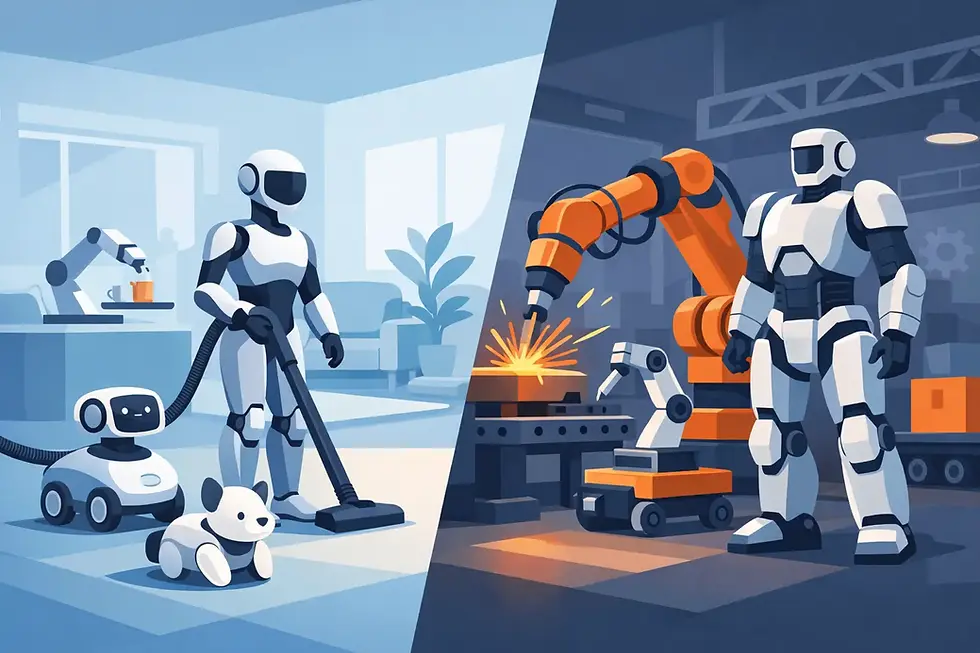
The first serious use cases will likely be structured environments where the robot can repeat semi-predictable tasks. Factories are the obvious candidate. Tesla has every reason to start there. It controls the environment, understands the workflows, and can use internal operations as a test bed. That is a smart path because industrial deployment gives the robot a chance to build competence before it faces the chaos of homes, hospitals, hotels, or retail spaces.
Home use is the dream everyone wants to jump to, but it is much harder. A household robot has to handle clutter, stairs, pets, children, edge cases, fragile objects, and endless variety. The leap from factory helper to daily domestic assistant is huge. It may happen eventually, but not on the same timeline as the hype cycle.
That does not reduce the excitement. It sharpens it. A robot that can take over dull, repetitive, or physically taxing work in commercial settings is already a major story. If that platform later evolves into a broader consumer machine, the category gets even more interesting.
So, is Tesla Optimus actually good?
Yes - as a direction, a platform, and a statement of intent, Optimus is one of the most compelling humanoid robots in the world right now.
Not yet - as a fully validated, widely deployed product that has proven it can transform labor at scale.
That split answer is the honest one. Optimus looks increasingly credible, which is more important than looking polished too early. Tesla seems to understand that the real win is not making a humanoid robot that photographs well. The real win is making one that works often enough, safely enough, and cheaply enough to matter.
For the audience watching the future of smart machines take shape, this is where the signal is strongest. Optimus is no longer just a conversation piece. It is becoming a serious commercial robotics project backed by one of the few companies bold enough to chase mass-market humanoids with real resources. That alone puts it in elite territory.
At We Are The Robots, this is exactly the kind of machine worth tracking closely - not because the story is finished, but because the next few iterations could define the category. If Tesla solves the hard middle between demo and dependable labor, Optimus will not just be a famous robot. It will be one of the products that made humanoids feel real.
The smartest way to look at Optimus is with excitement in one hand and skepticism in the other, because that is how breakthrough robotics usually arrives - messy at first, then suddenly impossible to ignore.


Comments