
The Future of Humanoid Robots
- Or Alkalay
- Jun 10
- 6 min read

A few years ago, humanoid robots were mostly concept videos, trade show moments, and research projects that looked impressive but felt far away. Now the future of humanoid robots is becoming a real market story, with serious companies building machines meant to walk into factories, warehouses, labs, retail spaces, and eventually homes. That shift matters because once a robot can operate in spaces built for people, the addressable market gets much bigger.
This is why the category has so much momentum right now. The world already has human-shaped environments - stairs, doors, tools, shelves, carts, kitchens, checkout areas, elevators, and workstations. A capable humanoid does not need society to rebuild the world around it. It needs enough perception, dexterity, balance, battery life, and intelligence to function inside the world we already use every day.
Why the future of humanoid robots feels closer now
The big change is not just hardware. It is the stack. Motors are getting better, batteries are improving, sensors are cheaper, and AI models are far more capable at interpreting messy real-world scenes than they were even a short time ago. Put that together and you get a machine that can do more than repeat one canned motion inside a perfectly controlled demo.
That does not mean humanoids are solved. Far from it. Walking reliably is hard. Manipulation is hard. Safe operation around people is hard. General-purpose autonomy is still very hard. But the gap between what companies can show in a lab and what they can test in real work settings is shrinking fast, and that is what has investors, manufacturers, and early adopters paying attention.
Another reason this category feels different is that the goal is no longer purely spectacle. The leading players are talking about labor gaps, repetitive industrial tasks, material handling, inspection, and support work. That is a more serious commercial story. A robot that can move bins, carry parts, sort items, or assist with routine workflows does not need science-fiction-level intelligence to be valuable.
Where humanoid robots will likely win first
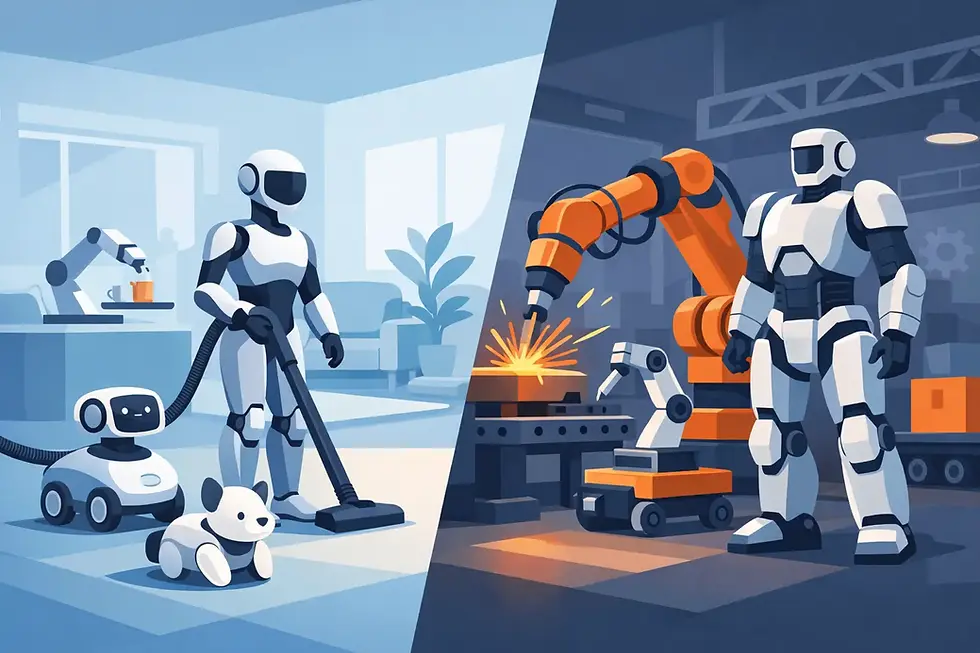
The most exciting version of the future is a humanoid in every home, helping with chores, errands, and elder support. That may happen in stages, but first wins will probably come in structured commercial environments.
Factories and warehouses
This is the obvious launch zone. Repetitive physical tasks, staffing pressure, safety protocols, and measurable return on investment make industrial sites the best proving grounds. A humanoid does not need to cook dinner to be useful. If it can transport totes, feed lines, inspect stations, or handle simple pick-and-place jobs, it starts to justify its cost.
Factories also offer a practical advantage: companies can limit variables. Workflows are more predictable than in homes, and robot fleets can be supervised closely. That makes it easier to improve performance through real deployment instead of endless theory.
Retail and hospitality
This category is more visible and more emotionally compelling, but also more chaotic. A humanoid that greets customers, guides visitors, restocks light items, or supports back-of-house operations could absolutely become a real product story. The challenge is that public environments are messy. People move unpredictably, children test boundaries, and brand expectations are high. A robot that fails in a warehouse creates operational friction. A robot that fails in front of customers becomes a viral clip.
Healthcare and elder support
The long-term upside here is massive, especially in aging societies. Humanoid robots could help with mobility support, fetching items, basic monitoring, and routine non-clinical assistance. But this is also where trust, safety, regulation, and emotional design matter most. For many users, technical performance alone will not be enough. The robot has to feel reliable, calm, and easy to interact with.
Homes
The home is the hardest market and the biggest prize. A consumer humanoid has to handle clutter, stairs, pets, varied lighting, narrow spaces, and endless edge cases. It also has to be affordable enough that people see it as a product, not a moonshot. That is why home humanoids may arrive later than the hype suggests. Still, once the economics improve and the software stack gets more flexible, the home will become one of the most important frontiers in robotics.
The technology that will decide the winners
Hardware gets attention because it looks dramatic on camera, but the future of humanoid robots will be decided by how well the full system works in the real world.
The first battleground is mobility. A robot has to walk, turn, recover, and move through imperfect environments without looking fragile. It does not need to dance on day one. It needs to stay upright, move with purpose, and operate for long enough to finish useful work.
The second battleground is hands. The jump from moving around a room to actually doing tasks is all about manipulation. Grippers, fingers, force control, object recognition, and precision matter more than flashy movement. A humanoid that can open containers, pick mixed items, use simple tools, and adapt to object variation becomes far more valuable than one that merely walks well.
The third battleground is intelligence. This is where things get especially interesting. Humanoids need multimodal AI - vision, language, memory, planning, and action tied together. A useful robot should be able to interpret instructions like a person would, understand context, and recover when something changes. That is a huge leap from scripted robotics.
Then there is cost. This may be the least glamorous factor and the most important. A humanoid can be astonishing, but if the economics do not work, deployment stays tiny. The companies that matter most in the next phase will not just build impressive robots. They will build robots that can be manufactured, maintained, updated, and scaled.
The biggest obstacles nobody should ignore
It is easy to get carried away in this category, especially when the demos are getting better every quarter. But trade-offs are real.
Battery life is still a major constraint. A humanoid doing real physical work consumes a lot of power, and limited runtime can make a promising machine less practical than it first appears. Safety is another major challenge, especially as these robots move closer to people in shared spaces.
Reliability will separate headlines from actual product-market fit. A robot that works 80 percent of the time is impressive online and frustrating on the floor. Businesses want consistency, maintenance support, and clear value. Consumers will demand even more because tolerance for glitches inside the home is much lower.
There is also the human side. Some people will see humanoids as helpful tools. Others will see labor disruption, privacy issues, or social discomfort. Both reactions are valid. The companies that win will not just engineer the machine. They will design trust around it.
What the next five years may look like
Expect the next wave to be less about science fiction and more about deployment footage, pilot programs, and commercial proof. The standout brands will be the ones that show measurable work completed, not just polished presentations. We will likely see more partnerships between robot makers and industrial operators, along with more pressure to demonstrate reliability at scale.
We will also see the category split. Some humanoids will be built mainly for industry. Others will lean into service, companionship, or brand experience. A few companies will chase general-purpose platforms that can move across use cases, but that is a harder path. Being amazing at one environment may beat being decent at ten.
The global leaders in this space are not only building machines. They are building ecosystems - software, training, simulation, fleet management, maintenance, and developer tools. That is a huge clue about where the market is going. The robot itself is only part of the product.
For enthusiasts, creators, and robotics-curious buyers, this is the moment to pay close attention. The category is crossing from fascinating prototype culture into something more commercial, more competitive, and much more visible. That does not mean every humanoid claim will come true on schedule. It means the race is real now.
At We Are The Robots, that is what makes this market so compelling. You are not just watching future tech from a distance anymore. You are watching the early product era of machines that could redefine labor, assistance, mobility, and even everyday ownership.
The smartest way to look at the future of humanoid robots is with excitement and discipline at the same time. Be impressed by the breakthroughs, but watch for the details that turn demos into products: runtime, dexterity, safety, repeatability, and cost. The magic is no longer in whether humanoids can exist. The magic is in which ones will actually earn a place in the real world.


Comments