
9 Robot Gadgets for Home Worth Watching Now

A robot that cleans under the sofa is useful. A robot that patrols the yard, plays with the dog, carries a tray, or holds a conversation changes the feeling of the house. That is why robot gadgets for home have become one of the most exciting frontiers in consumer tech. The category is no longer just about scheduling a vacuum at 10 a.m. It is about inviting mobile, sensing, increasingly intelligent machines into everyday life.
Some are ready to buy and genuinely practical. Others are early-stage marvels worth following because they reveal where the smart home is heading next. The trick is knowing the difference between a product that solves a real household job today and a spectacular demo that is still earning its place in the living room.
The Robot Gadgets for Home That Matter Most
1. Robot vacuums and mops
The robot vacuum remains the gateway machine for a reason: it works. The best current models map rooms, avoid cords and pet messes, vacuum carpets, mop hard floors, and return to a dock that empties debris and handles much of the cleaning cycle.
This is not the flashiest robot in the house, but it may be the one that earns its keep fastest. Homes with pets, kids, open floor plans, or lots of hard flooring see the biggest payoff. The trade-off is preparation. Floor clutter, high thresholds, tangled cables, and tight chair legs can still turn an autonomous cleaning mission into a rescue operation.
2. Robotic lawn mowers
Robotic mowers bring the same autonomous logic outside. They cut little and often, maintaining a tidy lawn without the weekly noise, fumes, and effort of a traditional mower. Newer systems can use cameras, GPS-style positioning, or boundary solutions to stay on course.
They make the most sense for homeowners with manageable, clearly defined yards. Complex slopes, loose landscaping, heavy leaf cover, and gates between lawn zones can make setup more demanding. Still, a mower quietly rolling across the grass while you drink coffee is exactly the kind of future-tech payoff people imagined.
3. Pool-cleaning robots
A pool robot is a specialist machine, and that is its strength. It does not need to be a general-purpose AI assistant. It needs to climb walls, collect debris, scrub surfaces, and save someone from spending a Saturday wrestling a vacuum hose.
For pool owners, these can be among the least gimmicky robot purchases available. Look at cleaning coverage, filter capacity, cable management, battery runtime, and whether the unit can handle the exact shape and surface of your pool. A low price is not always a bargain if the robot leaves the steps untouched every time.
4. Robotic window cleaners
Glass-heavy homes, apartments with difficult exterior windows, and modern offices have created a niche for window-cleaning robots. These machines attach to glass with suction, follow a cleaning pattern, and reduce the risky part of the job.
Their limitations are obvious but worth saying out loud: they are not ideal for every window, frame, or surface. They need reliable safety systems, clean pads, and supervision. Think of them as task-specific gear for awkward glass, not a magical replacement for every cleaning method.
5. AI companion robots
This is where the category gets personal. AI companion robots blend conversational software, expressive movement, cameras, microphones, and a physical presence that a phone or smart speaker cannot match. Some are designed as desktop personalities. Others act more like interactive family devices, responding to voice, faces, routines, and simple gestures.
The appeal is not only utility. A companion robot can bring character to a room, encourage a child to practice language, offer reminders, or simply become a conversation piece that feels more alive than another screen. But buyers should examine privacy controls closely. A friendly face with a camera and microphone deserves clear settings, transparent data policies, and the ability to mute or disable sensors when wanted.
6. Robotic pets
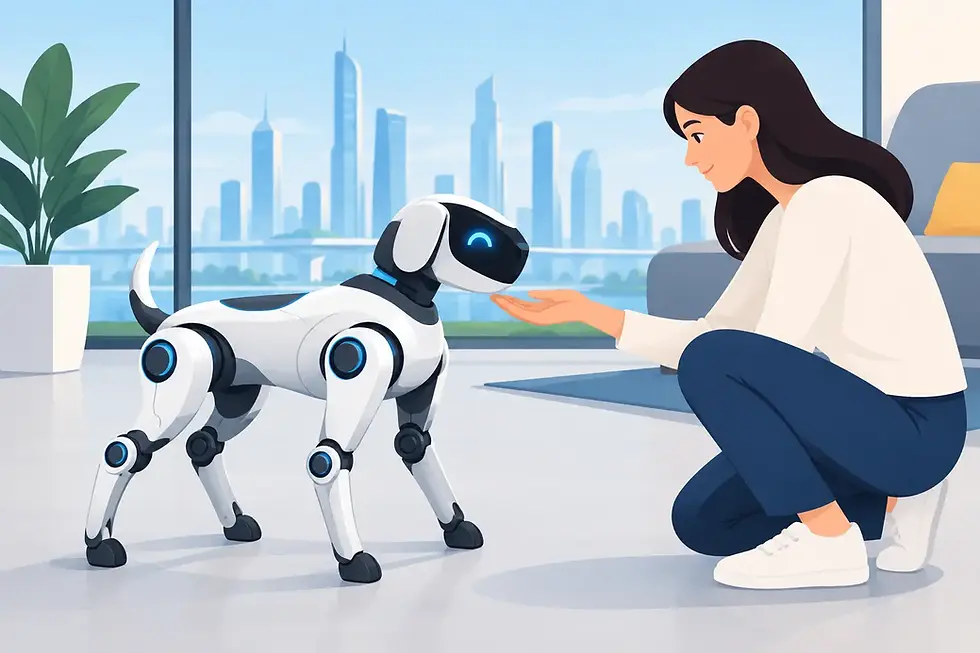
Robotic pets are among the most emotionally compelling home machines. They can wag, respond to touch, recognize people, play, and provide low-maintenance companionship. For people who cannot keep a live animal because of allergies, housing rules, travel, or caregiving limits, that proposition is bigger than novelty.
A robotic dog will not replace a real dog, and it should not be sold as if it can. It cannot offer the same responsibility, unpredictability, or biological bond. Yet advanced robotic pets can create a real sense of interaction, especially when expressive design meets responsive behavior. They are part toy, part social robot, part glimpse of a new category of home companion.
7. Home security and patrol robots
Cameras on wheels are evolving into mobile security robots that can move through a home, stream video, check a room, and respond to remote commands. The concept is compelling for frequent travelers, large properties, and anyone who wants more visibility than fixed cameras can provide.
The catch is that a moving camera changes the privacy conversation. Every household member and guest should know it exists. These robots also need dependable navigation and charging, because a security bot that gets stranded behind a laundry basket has missed the point. Used thoughtfully, however, mobile monitoring is a major step beyond the static smart camera.
8. Consumer quadrupeds
Four-legged robots have leapt from research labs into the public imagination. Machines from companies such as Unitree show just how agile a compact quadruped can be, walking over uneven ground, carrying small loads, filming dynamic footage, and becoming the undisputed star of a backyard gathering.
For most homes, a quadruped is still an enthusiast purchase rather than a household necessity. Prices, safety, software maturity, noise, and practical use cases all matter. But creators, developers, educators, and early adopters should pay attention. The skills these robots are learning - perception, balance, navigation, and interaction - will influence many future home machines.
9. Humanoid home helpers
Humanoid robots are the big dream: a machine that can operate in spaces built for humans, use familiar tools, carry items, open doors, and eventually assist with chores. Tesla Optimus, Figure, and other major efforts have made the idea impossible to ignore.
The honest answer is that fully capable humanoid home helpers are not mainstream consumer appliances yet. Demos can be impressive, but a controlled demonstration is not the same as reliable all-day operation in a messy, unpredictable home. A truly useful humanoid must handle safety, dexterity, cost, battery life, stairs, pets, children, and thousands of weird edge cases.
That said, the momentum is real. The first home humanoids may begin with narrow tasks, supervised operation, or premium early-adopter programs. Watching the field now is worthwhile because this category could redefine what “smart home” means more dramatically than any app-controlled lightbulb ever did.
How to Choose Robot Gadgets for Home Without Buying Hype
Start with the job, not the robot. If the goal is cleaner floors, a mature robot vacuum with strong service support is more valuable than an experimental device with a dazzling social media clip. If the goal is inspiration, education, or content creation, an AI pet or quadruped may deliver far more joy than a purely practical machine.
Then look at the environment. Robots live or die by real-world conditions: thresholds, rugs, stairs, Wi-Fi coverage, pet hair, narrow hallways, outdoor weather, and the people who share the space. Measure door clearances. Check where the charging dock will sit. Ask what happens when the internet goes down, the battery degrades, or the robot needs repair.
Also consider the ownership layer. A home robot may require replacement parts, cloud features, subscriptions, firmware updates, and customer support that remains available after launch excitement fades. The most futuristic machine is not always the best buy if it becomes useless when an app changes or a company disappears.
The Home Is Becoming a Robot Platform
The most interesting shift is not that every household will suddenly own a humanoid. It is that homes are becoming ready for mobile intelligence. Maps, sensors, voice control, better batteries, computer vision, and generative AI are giving machines more ways to understand rooms and respond to people.
That creates a spectrum of robot ownership. One household may start with a vacuum. Another may add a robotic pet, a pool cleaner, and a mobile camera. A creator may experiment with a quadruped. An early adopter may someday welcome a humanoid helper. Each machine has a different purpose, but together they make the home feel less like a collection of appliances and more like an environment with active, responsive technology.
At We Are The Robots, that is the fun part: following the machines before they become ordinary. Choose the robot that solves a real problem or sparks genuine curiosity, give it a clear role at home, and keep an eye on what arrives next. The robot revolution will not enter through one dramatic doorway. It will roll, walk, clean, listen, and play its way into the rooms we already know.


Comments