Do Humanoid Robots Learn? Yes, but Not Like Us

A humanoid robot picks up a laundry basket, misses the handle, adjusts its grip, and tries again. That moment looks simple, but it answers a huge question: do humanoid robots learn? Yes. The catch is that their version of learning is still very different from human learning. A robot can become better at a task through data, simulation, demonstrations, and feedback. It does not yet understand the world with the flexible common sense of a person.
That distinction matters as humanoids move out of carefully controlled lab demos and toward factories, warehouses, retail spaces, and eventually homes. The future of smart machines is not just about walking on two legs. It is about whether those machines can handle the weird, changing, gloriously unstructured reality around us.
Do Humanoid Robots Learn From Experience?
They can, but the answer depends on what we mean by experience. Humanoid robots learn through a stack of systems rather than one all-purpose robot brain. A model may recognize objects through cameras, estimate distance through depth sensors, plan a route, balance the body, and control the fingers. Each layer can improve with training.
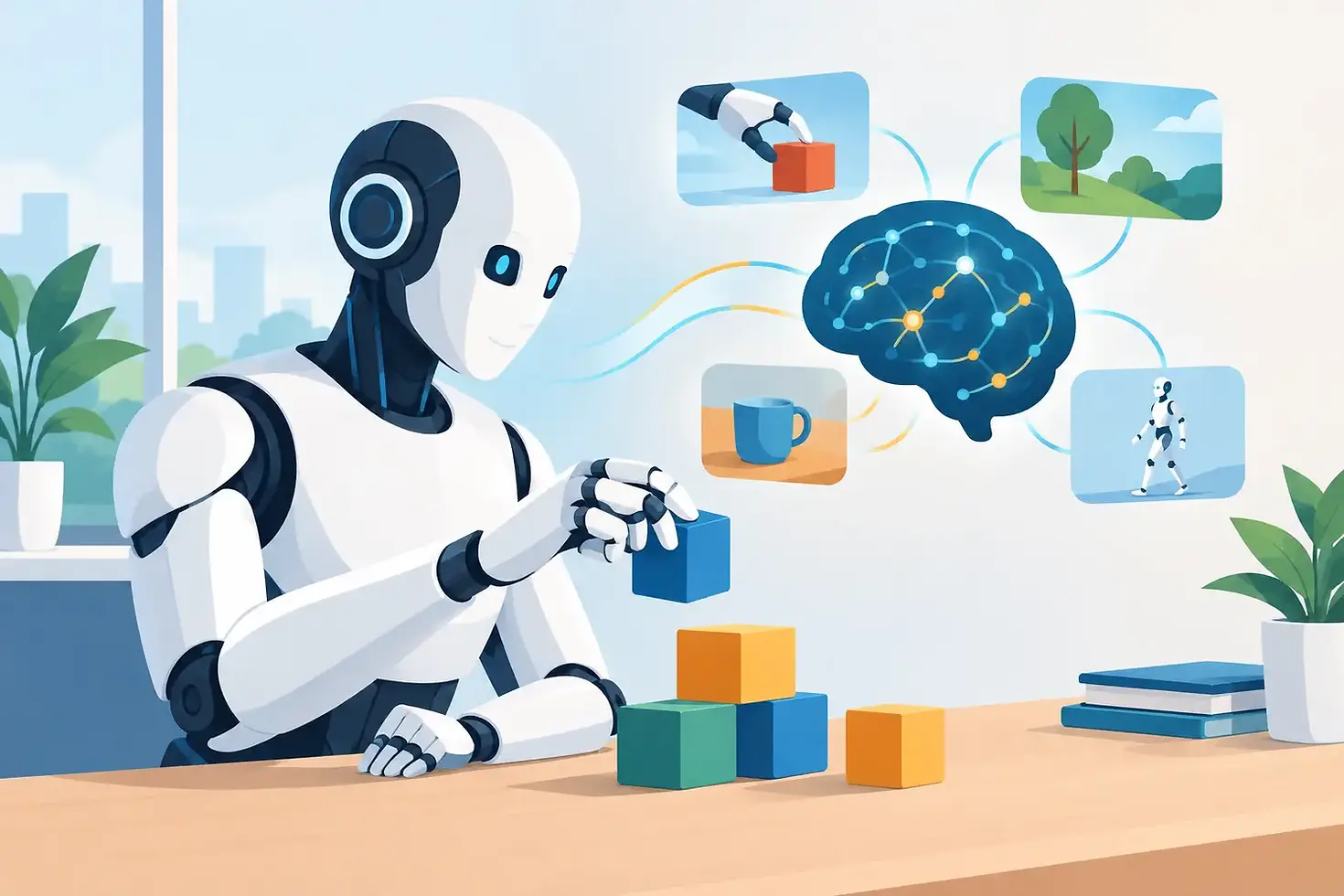
One major approach is machine learning from examples. Engineers show a system thousands or millions of images, videos, simulated scenarios, or recorded robot actions. Over time, the model identifies useful patterns. It may learn that a mug has a handle, that an open cabinet creates a collision risk, or that soft packaging needs a gentler grip than a metal tool.
Another approach is imitation learning. A human operator performs a movement, sometimes remotely through teleoperation, and the robot records the result. The machine then attempts to reproduce the behavior. This is especially powerful for tasks that are annoying to program step by step, such as folding fabric, sorting mixed items, or loading an unfamiliar object into a bin.
Reinforcement learning adds another ingredient: consequences. The robot tries actions and receives a reward for outcomes that match the goal. Stay upright, place the object in the right location, finish quickly, avoid collisions. In simulation, a robot can repeat a task at astonishing speed without breaking expensive hardware. That lets teams train balancing, locomotion, reaching, and recovery behaviors before sending the policy into a physical robot.
Why a Robot Demo Is Not the Same as Learning
A slick demo can make a humanoid look almost magical. Watch a robot walk, wave, sort parts, or carry a tote and the instinct is to assume it can handle anything nearby. Usually, it cannot. At least not yet.
Many robot behaviors are trained for a constrained environment. The lighting is known. The objects are familiar. The floor is clear. The task has a defined beginning and end. That is still valuable - factories and warehouses often benefit enormously from repeatable environments - but it is not the same as broad intelligence.
The real test is generalization. Can the humanoid pick up a box it has never seen? Can it keep working when the label is partly torn, the aisle is narrower than expected, or a person leaves a cart in its path? Can it recover safely when a cable catches or an object slips from its hand?
This is where the most exciting robotics companies are concentrating their energy. Tesla Optimus, Figure, Unitree, Boston Dynamics, and a fast-growing field of global builders are not chasing movement for movement's sake. They are trying to create machines that can turn perception into useful action under real conditions.
The Four Ways Humanoids Improve
Humanoids do not all learn in the same place or on the same schedule. Some improvement happens before deployment, some happens during testing, and some can happen after a robot reaches a customer site.
Training in simulation is fast and cheap. Digital worlds let engineers vary surfaces, object positions, camera angles, and unexpected disruptions. The weakness is the sim-to-real gap. A simulated cardboard box does not bend, scrape, or slide exactly like a real one.
Learning from human demonstrations brings real-world nuance into the process. People naturally adjust their hands, posture, and speed. Capturing those examples gives the robot a practical starting point, though collecting high-quality demonstrations at scale takes time and money.
Fleet learning may be the biggest long-term advantage. If many robots encounter similar tasks, their performance data can help improve future versions of the model. One robot's failed grasp can become a useful lesson for thousands of machines, assuming privacy, safety, and customer data rules are handled responsibly.
On-robot adaptation is the most compelling and the most sensitive category. A humanoid that can fine-tune behavior in a live environment could become far more useful. But nobody wants a heavy, mobile machine making uncontrolled experiments around people. In practice, companies will likely limit live adaptation, validate changes carefully, and use remote oversight for high-value or safety-critical work.
What Humanoid Robots Can Learn Today
The strongest current use cases are not glamorous. They are repetitive, physical, and structured enough to measure. A humanoid can learn to move totes, inspect components, place products, open simple doors, transfer materials, or perform basic machine-tending motions. Those tasks matter because labor shortages, workplace ergonomics, and operational consistency are real business problems.
Vision-language-action models are also pushing the category forward. These systems connect language instructions, visual understanding, and physical movement. Instead of building a separate command sequence for every variation, an operator may be able to say, “put the blue container on the shelf,” while the robot uses its cameras and learned physical skills to carry out the request.
That does not mean a robot understands language the way a person does. It means the system can map words and visual cues to patterns it has learned. Give it an ambiguous instruction, an unfamiliar object, or a task with hidden social rules, and the gap becomes obvious.
Where Robot Learning Still Breaks
Hands are a major problem. Human hands are extraordinary: sensitive, adaptable, and capable of handling everything from a paper cup to a shoelace. Robotic hands are improving quickly, but dexterity remains expensive, difficult, and heavily dependent on sensing and control.
Energy is another constraint. A humanoid needs power for computing, cameras, motors, cooling, balance, and manipulation. A robot that can work brilliantly for a short session but spends too much time charging will struggle to earn its place on a commercial floor.
Then there is the long tail of reality. People are excellent at handling rare events because we bring broad experience, judgment, and common sense. Robots need examples or carefully designed policies for much of what they encounter. A crumpled bag, a reflective surface, a pet underfoot, or an object positioned just slightly wrong can still create a failure that looks surprisingly basic.
Safety changes the equation, too. Learning systems are built to explore, but physical robots must operate within strict limits. The more forceful, mobile, and autonomous a humanoid becomes, the more carefully its behavior must be tested. Faster learning is exciting. Reliable learning is what makes it commercially real.
The Shift From Scripted Machines to Useful Teammates
For decades, industrial robots succeeded by doing a narrow job with extreme precision. Humanoids are aiming at a different target: flexible work in spaces built for people. Stairs, doors, shelves, tools, carts, and workstations already fit the human body. That is why the humanoid form is so commercially interesting.
The winning machines will not necessarily be the ones with the most dramatic videos. They will be the robots that improve at a measurable task, recover from ordinary mistakes, operate safely, and deliver value day after day. Learning is the engine behind that transition.
For buyers, creators, and robotics watchers, the smart question is not whether a humanoid can perform one impressive trick. Ask what data trained it, how it handles variation, whether it can be updated, and what happens when the task goes wrong. At We Are The Robots, that is the lens worth bringing to every new demo: look past the spectacle, then imagine what the machine could do after another million real attempts.


Comments