
Robot Trends Reshaping the Machines We Want

A humanoid folding laundry, a quadruped climbing factory stairs, and an AI pet reacting to its owner are no longer isolated viral moments. The biggest robot trends are turning robotics into something people can watch, compare, imagine using, and in a growing number of cases, actually buy. The future of smart machines is arriving in public - through demos, developer kits, pilot programs, and consumer-ready companions.
That does not mean every impressive robot is ready to work a full shift in your home. Robotics remains difficult, expensive, and gloriously unpredictable. But the direction is clear: machines are becoming more mobile, more expressive, more AI-native, and more focused on real environments rather than carefully controlled labs.
Robot Trends Moving Beyond the Demo Stage
For years, robotics was dominated by industrial arms built to repeat one exact task behind safety barriers. Those systems remain essential, but the next wave is being designed for the messy places humans live and work: warehouses, offices, hospitals, stores, sidewalks, and eventually homes.
The change is not just mechanical. Better sensors, cheaper compute, improved batteries, simulation, and generative AI are combining to give robots a broader understanding of their surroundings. A machine does not need human-level intelligence to become useful. It needs to see what is in front of it, move safely, recover from mistakes, and perform a valuable task often enough to justify its cost.
That sounds simple. It is not. A robot that can make a perfect demonstration look easy may still struggle with glare on a floor, an unexpected object, a loose cable, or a person stepping into its path. The most exciting companies are now showing progress where it counts: repeatable work in changing environments.
Humanoids are becoming a serious product category
Humanoid robots command attention because the human world is already built for human bodies. Doors, stairs, shelves, carts, tools, kitchens, and workstations all assume a person with two arms, hands, and legs. Rather than rebuild every environment for a machine, a humanoid aims to fit into the environment we already have.
Tesla Optimus, Figure, Unitree, and other global leaders are pushing this category forward with different approaches to mobility, dexterity, training, and deployment. Some are focused on factory and warehouse work first. Others are building lower-cost platforms that creators, researchers, and early adopters can explore sooner.
The near-term reality is likely less dramatic than science fiction. Expect humanoids to begin with constrained jobs: moving bins, sorting items, tending machines, carrying materials, and completing repetitive tasks in mapped spaces. That is still a massive opportunity. A robot does not need to cook dinner, repair a roof, and walk the dog to change the economics of physical work.
For buyers and fans, the key signal is not whether a humanoid can dance. It is whether it can perform a useful sequence repeatedly, at a credible speed, with minimal human intervention. Great demos create excitement. Reliable task completion creates a market.
Quadrupeds are finding their footing
Four-legged robots have a practical advantage: they can move through terrain that defeats wheels. Stairs, gravel, narrow walkways, uneven industrial sites, and outdoor facilities are all more approachable when a robot has legs.
Boston Dynamics helped define the public image of the advanced quadruped, while Unitree and others have made the category more visible and accessible. These machines are increasingly used for inspection, mapping, remote observation, security patrols, and research. Equipped with cameras, thermal sensors, lidar, or specialized payloads, a quadruped can be a set of mobile eyes in places that may be difficult, repetitive, or hazardous for people.
There is a trade-off. Legged movement is energy-intensive, and a quadruped can be more costly and complex than a wheeled robot built for flat ground. For a predictable warehouse aisle, wheels often win. For a construction site, utility facility, or multi-level industrial space, the robot dog starts to make much more sense.
AI Companions Are Giving Robots Personality
The most emotionally powerful robot trend may not be the strongest or fastest machine. It may be the one that makes eye contact, remembers a preference, responds to your voice, or simply feels present in a room.
AI companions and robotic pets are bringing robotics closer to consumer electronics. These products do not need to solve warehouse logistics to earn a place in people’s lives. They need to be engaging, dependable, and clear about what they are for: companionship, play, education, accessibility, entertainment, or a daily prompt to interact with technology in a more physical way.
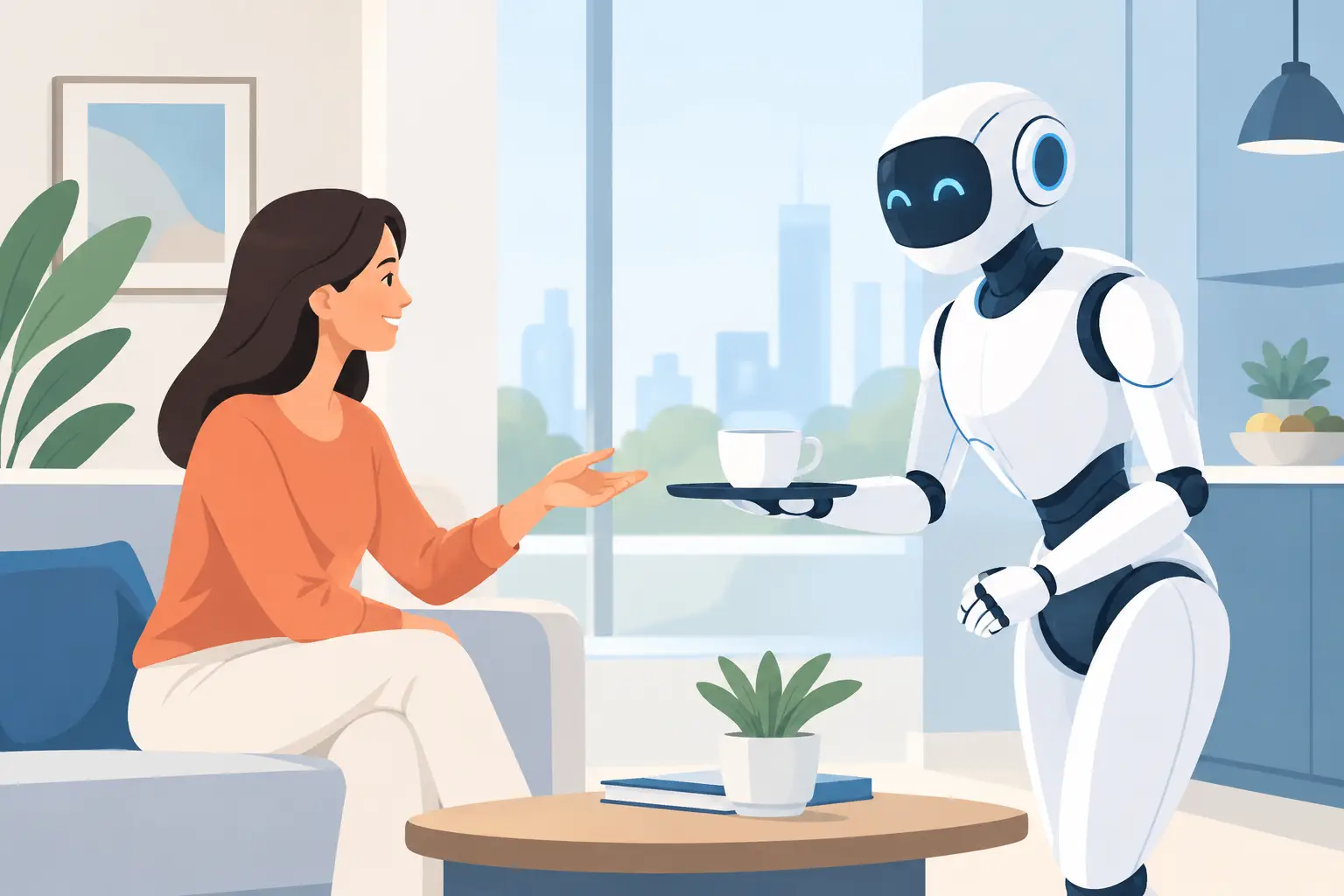
A screen-based AI assistant can answer questions. A robot companion can turn, react, gesture, make sounds, follow a user, and create the feeling of shared space. That physical presence is the product. It can be delightful, especially for families, kids learning to code, older adults, and anyone who wants technology with more character than a black rectangle on a desk.
Still, personality creates higher expectations. If a robotic pet appears emotionally aware but frequently fails to understand simple interaction, the magic disappears quickly. The best companion robots will balance charm with honest capabilities. They should not pretend to be more autonomous, private, or emotionally intelligent than they really are.
The body is becoming the interface
A major shift is happening in how people interact with AI. Instead of typing prompts into an app, users will increasingly speak, point, demonstrate, guide, and physically collaborate with machines. Vision-language-action models are helping robots connect what they see with what they are told to do.
Imagine saying, “Put these items on the table,” while a robot identifies the objects and navigates around a chair. Or showing a machine how to complete a simple task, then having it repeat the action. This is the long-term promise: less programming for every movement, more natural instruction.
But the gap between a compelling research demo and a safe consumer product remains large. Physical AI has consequences. A chatbot can give an odd answer; a robot can bump into furniture, mishandle an object, or create a safety issue. Trust will be built through careful limits, transparent behavior, emergency controls, and design that puts people first.
The Real Race Is Reliability, Not Hype
There is no shortage of spectacular robot videos. The harder question is what happens after the cameras stop rolling.
The companies most likely to win will not necessarily be the ones with the flashiest launch. They will be the ones that can manufacture at scale, support deployments, collect data responsibly, improve software continuously, and prove a return on investment. In commercial settings, a robot has to fit into an operation without creating more work for the humans around it.
That is why narrow applications matter. A robot that handles one task exceptionally well can be more valuable than a general-purpose machine that does ten tasks poorly. The path to truly flexible robots may be built from thousands of focused deployments, each teaching systems how the real world behaves.
For consumers, the equivalent test is simpler: does this robot earn a place in my life after the first week? A robotic pet must remain interesting. A home robot must save time or add real value. A developer platform must offer enough capability to justify the learning curve and price.
What to Watch Before You Buy or Follow a Robot
When a new machine appears, look past the launch reel. Ask where it operates, what it can do without human help, how long it runs between charges, and whether the company has demonstrated the same task over time. Consider service, replacement parts, software updates, privacy policies, and whether the product is available now or only planned.
Also separate aspiration from fit. A $10,000 quadruped may be an extraordinary platform for a lab, film crew, or industrial inspection team, but it may be excessive for a casual enthusiast. A smaller AI companion might deliver more daily enjoyment for a household, even if it has far less technical power. The right robot depends on whether you want a tool, a creative platform, a conversation piece, or a glimpse of what comes next.
At We Are The Robots, that is the thrill worth following: not a distant fantasy, but a growing world of machines with distinct abilities, personalities, and purposes. Watch the demos closely, celebrate the breakthroughs, and keep asking the question that matters most: what could this robot do in the real world tomorrow?


Comments