Robots for Home Use Are Finally Getting Real
- Or Alkalay
- Jun 17
- 5 min read

A few years ago, most talk about robots for home use felt like a trailer for a future that never quite arrived. Now the category is starting to split into something much more interesting: machines that actually do useful work, machines that keep you company, and machines that give you a front-row seat to where consumer robotics is heading next.
That shift matters. Home robots are no longer one single idea. They are becoming a real product landscape, with different price points, different personalities, and very different expectations. If you are a tech-forward buyer, a robotics fan, or someone tracking the next big consumer hardware wave, this is where things get exciting.
What robots for home use really means now
When people hear the phrase robots for home use, they often imagine humanoids folding laundry, carrying groceries, and managing the whole house. That vision is still in motion, but the real market is broader and more practical than that.
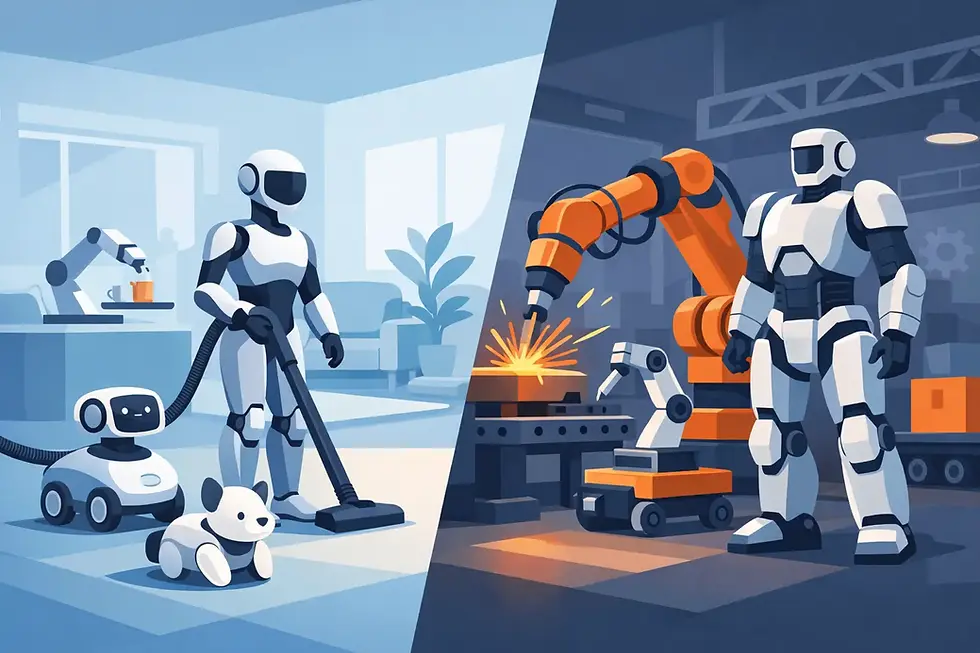
Today, home-use robots fall into a few strong categories. There are task robots that clean floors, patrol property, or handle repetitive chores. There are companion robots and AI pets built around interaction, emotion, and presence. Then there are advanced showcase machines - humanoids, quadrupeds, and smart mobile platforms - that are not fully mainstream household appliances yet, but are rapidly shaping what consumers will expect next.
The biggest mistake is judging all of them by one standard. A robotic vacuum should be measured by reliability and time saved. A companion robot should be measured by engagement, personality, and usefulness in daily interaction. A humanoid prototype should be judged by capability trajectory, not whether it can already replace three household staff members.
Why the market feels different this time
The energy around home robotics is stronger now because several technologies are maturing at once. AI systems are better at speech, recognition, and adaptation. Sensors are cheaper. Battery performance is more practical. Hardware design has improved. And most importantly, people are getting more comfortable living with intelligent machines.
That last point is easy to underestimate. The path to mainstream adoption is not just about engineering. It is also about trust. People need to feel that a robot belongs in their home, adds value, and does not create more friction than it removes.
That is why simpler robots often win first. A floor-cleaning robot with solid navigation solves an obvious problem. A robotic pet that offers companionship without the demands of a live animal fills a real emotional niche. A mobile home assistant with cameras and voice interaction can make sense for security-conscious users, families, or older adults. These are not science-fiction use cases. They are consumer behavior signals.
The three big categories to watch
Utility robots
This is the most mature segment. These robots do one job, or a tight cluster of jobs, and they do it with enough consistency to justify the cost. Cleaning remains the clearest example because it is repetitive, measurable, and annoying enough that people happily automate it.
But utility is expanding. Lawn care, pool maintenance, window cleaning, home monitoring, and basic delivery inside a property are all areas where robotics can make sense. The winning products here are rarely the most dramatic. They are the ones that work often enough that owners stop thinking about the task entirely.
Companion robots and AI pets
This category is underestimated by people who only think in terms of chores. Not every robot needs to scrub, lift, or organize. Some are designed to interact, comfort, entertain, or create a sense of connection.
That can sound soft compared with industrial-grade robotics, but it is commercially powerful. People name these machines. They talk to them. They share them. In a home setting, personality can be a feature, not a gimmick. For children, older adults, solo users, and robotics enthusiasts, a well-designed AI companion can feel more relevant than a machine that only performs one narrow task.
The trade-off is obvious. Companion value is subjective. One person sees delight and engagement. Another sees an expensive novelty. That means this category lives or dies by design quality, interaction depth, and the ability to stay interesting after the first week.
Advanced humanoids and quadrupeds
This is where the future starts looking very real. Humanoids and quadrupeds are still early for broad home adoption, mostly because cost, safety, and practical deployment remain major hurdles. But they matter now because they are shaping the roadmap.
A humanoid robot is compelling for home use because the world is built for human bodies. Doors, stairs, counters, tools, shelves, and household workflows all favor a human-like machine. A quadruped, meanwhile, brings mobility, balance, and a striking physical presence that can fit inspection, patrol, education, and entertainment use cases.
For early adopters and market watchers, these platforms are not just products. They are signals. They show how fast robot intelligence, locomotion, and human interaction are moving toward the consumer layer.
What buyers should actually look for
The smartest way to evaluate robots for home use is not to ask, "Is this futuristic?" It is to ask, "What happens after day 30?"
If the robot is still saving time, still creating value, or still delivering an experience you care about, it has real staying power. If it becomes furniture after the novelty wears off, that is a warning sign.
Autonomy is one of the biggest differentiators. Some robots are genuinely capable of handling tasks with minimal supervision. Others need constant setup, intervention, or environmental adjustments. The more a robot depends on ideal conditions, the narrower its real-world usefulness becomes.
Maintenance matters too. Charging, cleaning, software updates, replacement parts, and app reliability can decide whether a product feels premium or frustrating. A great demo is one thing. Everyday ownership is another.
Then there is integration. The best home robots do not exist as isolated gadgets. They fit into routines. They work with voice controls, home systems, cameras, schedules, or user preferences. The future of consumer robotics is not just better hardware. It is better orchestration.
The biggest gap between hype and reality
The gap is not that robots are fake. The gap is that people expect general-purpose capability too early.
A robot that can do one thing extremely well is often more valuable than a robot that can attempt ten things badly. Consumer markets reward trust. If a machine consistently cleans, patrols, responds, or interacts in a satisfying way, people forgive its limits. If it promises everything and fumbles basic actions, enthusiasm fades fast.
This is especially true in the home. The home is chaotic. Lighting changes. Floors vary. Pets move unpredictably. People leave objects everywhere. A robot operating in that environment needs more than flashy engineering. It needs resilience.
That is why the next wave will likely arrive in layers. First, more specialized robots will get better and cheaper. Then multi-function home robots will appear in premium segments. After that, truly flexible household humanoids may start moving from showcase status to selective ownership.
Why this category is worth following right now
We are at a rare moment where the consumer robotics story is no longer just aspirational and no longer fully mature. That middle phase is where the most interesting products appear.
Some will be weird. Some will be overhyped. Some will quietly become category leaders because they solve one household problem so well that users never want to go back. That mix is exactly what makes the space worth watching.
For enthusiasts, this is a chance to track the brands and machines defining the future of smart machines before they become obvious to everyone else. For buyers, it is a chance to spot where real value is emerging. And for creators, educators, and product scouts, home robotics is becoming one of the most vivid windows into how AI leaves the screen and enters physical life.
At We Are The Robots, that is the thrill of the whole category. You are not just looking at gadgets. You are watching the early consumer layer of a major technological shift.
The best way to think about home robots now is simple: buy for what they can genuinely do today, but watch them for what they are becoming tomorrow. That is where the real momentum is.


Comments