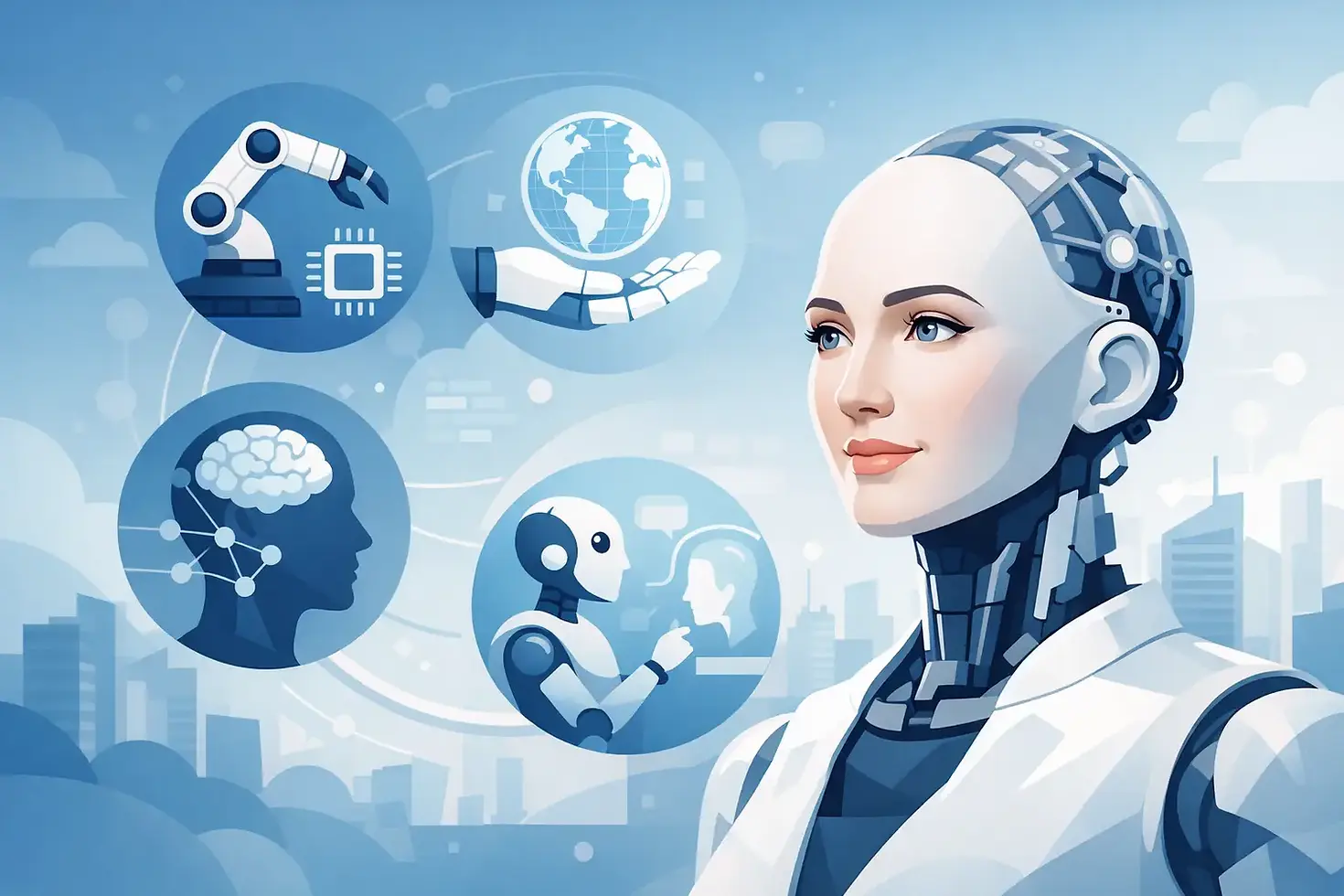
Sophia Robot Capabilities Explained

Most humanoid robots look impressive in photos. Sophia became famous because she could do something rarer - hold attention in a room full of humans.
That is the real starting point for understanding sophia robot capabilities. Sophia is not just a machine with a face. She is a social humanoid platform built to communicate, perform, demonstrate AI interaction, and spark serious debate about where human-robot relationships are heading. If you want to know what she can actually do, you have to separate the stage-ready wow factor from the deeper technical reality.
What Sophia Is Designed to Do
Sophia was developed by Hanson Robotics as a humanoid robot centered on social interaction. That design goal matters because it shapes everything else. Sophia is not trying to be a warehouse robot, a factory arm, or a quadruped built for rough terrain. She is built to engage people through conversation, facial expression, and humanlike presence.
That makes her capabilities very different from task-first robots. Sophia's strength is not lifting heavy objects or moving through difficult environments. Her strength is creating a memorable interaction that feels closer to talking with a person than tapping commands into a screen.
For robotics fans, this is why Sophia remains such a recognizable machine. She sits at the intersection of AI assistant, animatronic face platform, research robot, and media phenomenon. That combination is unusual, and it is exactly why people still search for her years after her first viral appearances.
Sophia Robot Capabilities in Plain English
If we strip away the headlines, sophia robot capabilities fall into a few core areas: speech interaction, face tracking, facial expression, scripted and semi-dynamic conversation, and public-facing presentation.
Sophia can speak using natural language output and respond in ways that appear conversational. In many settings, this relies on a mix of AI systems, speech processing, prepared dialogue flows, and operator-guided structure depending on the event. That does not make the performance fake. It makes it staged to varying degrees, which is common across many advanced robot demos.
She can also recognize faces and maintain eye contact behavior, which is a huge part of why her presence feels striking. Humans are extremely sensitive to gaze, expression, and timing. Sophia uses those cues well enough to create the sense of social awareness, even when the underlying intelligence is narrower than people imagine.
Her face is one of her biggest technical signatures. Using an expressive facial system, Sophia can display a range of emotions and reactions. Smiles, eyebrow movements, subtle mouth changes, and attentive expressions give her a level of social readability many robots still lack. In a demo environment, that matters as much as raw AI.
The Power of Facial Expression
A lot of humanoid robots can move. Far fewer can perform emotion in a way people instantly understand.
Sophia's face was designed to be a communication interface as much as a mechanical structure. When she reacts to a question, pauses before answering, or shifts expression mid-conversation, the interaction feels more alive. That emotional signaling is a major part of her capability set, even though it is easy to underestimate compared with terms like machine learning or language models.
This is also where Sophia changed public expectations. She helped push the idea that a robot's value is not only in physical labor but in social presence. For companion robotics, education, hospitality, events, and brand experiences, that is a very big deal.
There is a trade-off, though. Hyper-visible facial expression raises expectations for human-level understanding. People assume a robot that looks socially aware must also think deeply. In practice, appearance can outpace cognition.
How Smart Is Sophia, Really?
This is the question everybody wants answered, and the honest answer is: it depends on the context.
In a controlled interview, stage event, media demonstration, or exhibition booth, Sophia can appear highly intelligent because the environment is optimized for interaction. Questions may be predictable, the dialogue system may be tuned to a topic, and human operators may support the flow behind the scenes. That is not unusual in robotics. It is how many showcase platforms deliver polished experiences.
In open-ended, unpredictable conversation, the limits become clearer. Sophia does not operate like an all-purpose human mind. She does not possess broad real-world understanding, independent reasoning across any topic, or fully autonomous social intelligence that matches a person. Her intelligence is best viewed as a layered system for conversation, expression, and interaction rather than a general artificial being.
That distinction matters because it keeps expectations grounded. Sophia is impressive, but she is impressive in a specific category: embodied social robotics.
Mobility and Physical Abilities
When people hear "humanoid robot," they often picture full-body movement on the level of science fiction. Sophia is not primarily known for advanced locomotion or dexterous manipulation.
Her public identity is built around the upper-body social experience - face, voice, head movement, and human engagement. Some versions and demos have included body integration and movement updates, but mobility is not the central reason Sophia stands out in the market.
Compared with newer humanoids that focus on walking, lifting, logistics, or industrial deployment, Sophia plays a different game. She is closer to a social interface robot than a labor robot. That makes her less practical in some commercial categories, but much stronger in branding, public interaction, education, and media visibility.
Where Sophia Actually Fits in the Real World
The most realistic use cases for Sophia are the ones that benefit from attention, engagement, and human curiosity.
She fits naturally in conferences, televised appearances, museum installations, education programs, innovation showcases, hospitality experiments, and brand activations. In these spaces, the robot is not only delivering information. She is creating an experience people remember, film, discuss, and share.
That matters more than some critics admit. Social robots do not need to replace humans to have commercial value. Sometimes their role is to attract crowds, represent an innovation brand, or make AI feel tangible. Sophia has been one of the strongest examples of that model.
For educators and researchers, she also works as a gateway robot. People who might never read a technical paper on affective computing or human-robot interaction will still pay attention to Sophia. That visibility helps pull broader audiences into the robotics conversation.
The Limits Behind the Hype
Sophia's fame has always created a tension between what the robot symbolizes and what the robot can do right now.
The symbol is huge. Sophia represents a future where robots communicate with us in humanlike ways, occupy public spaces, and become recognizable personalities. That is powerful branding for the entire robotics industry.
The practical limitations are just as real. Her conversation can be narrow. Her autonomy is bounded. Her usefulness outside social and promotional settings is limited compared with robots built for delivery, manufacturing, security, or mobility. If you evaluate her as a utility machine, you will probably undersell her. If you evaluate her as a social robotics platform and global robotics ambassador, the picture changes.
This is why Sophia still matters. She is not the final form of humanoid robotics. She is one of the most visible stepping stones.
Why Sophia Still Matters in 2025
The robotics market is moving fast. We now have more serious talk around humanoids for labor, AI companions for the home, and smart machines that blur the line between product and personality. In that landscape, Sophia remains relevant because she proved the market value of robot identity.
People do not just remember her specifications. They remember her face, her interviews, and the feeling of seeing a robot participate in human conversation. That is a different kind of capability - cultural capability. Very few robots achieve it.
For a platform like We Are The Robots, that makes Sophia impossible to ignore. She is part machine, part media event, and part forecast of where consumer-facing robotics may go next. As AI gets better and hardware becomes more expressive, the category Sophia helped popularize could become much more capable, more personal, and much more commercial.
Sophia Robot Capabilities and the Bigger Picture
If you are evaluating sophia robot capabilities today, the smartest approach is to see both layers at once. On one layer, she is a highly effective social humanoid with strong facial expression, conversational presentation, and unmatched public recognition. On the other, she is still limited by the reality of current embodied AI, structured interaction design, and narrow real-world autonomy.
That is not a disappointment. It is the story of modern robotics in one machine. We are building robots that can impress, communicate, and connect before they can fully understand or independently act at human level.
And honestly, that is still a thrilling place to be. Sophia shows what happens when engineering, design, AI, and performance come together in a form people instantly care about. If you want to track where social humanoids are heading next, keep watching the robots that can make a room stop talking and start staring.


Comments