
How to Compare Humanoid Robots Before You Buy
- Or Alkalay
- Jul 13
- 7 min read

A humanoid robot can fold laundry in a polished video, walk through a warehouse, or hold a conversation with a visitor. Those are all impressive moments. But if you want to know how to compare humanoid robots, look past the highlight reel and ask a tougher question: what can this machine repeat safely, reliably, and economically in the real environment where it will operate?
The category is moving at extraordinary speed. Tesla Optimus, Figure, Unitree, Apptronik, Agility Robotics, Boston Dynamics, and a growing field of global builders are taking very different routes toward the same big idea: a general-purpose machine built for human spaces. Some prioritize factory work. Some chase mobility. Some are designed to be research platforms. Others aim to become familiar faces in homes, retail, and hospitality.
A great comparison does not start with the robot that looks most human. It starts with the job.
Start With the Mission, Not the Mascot
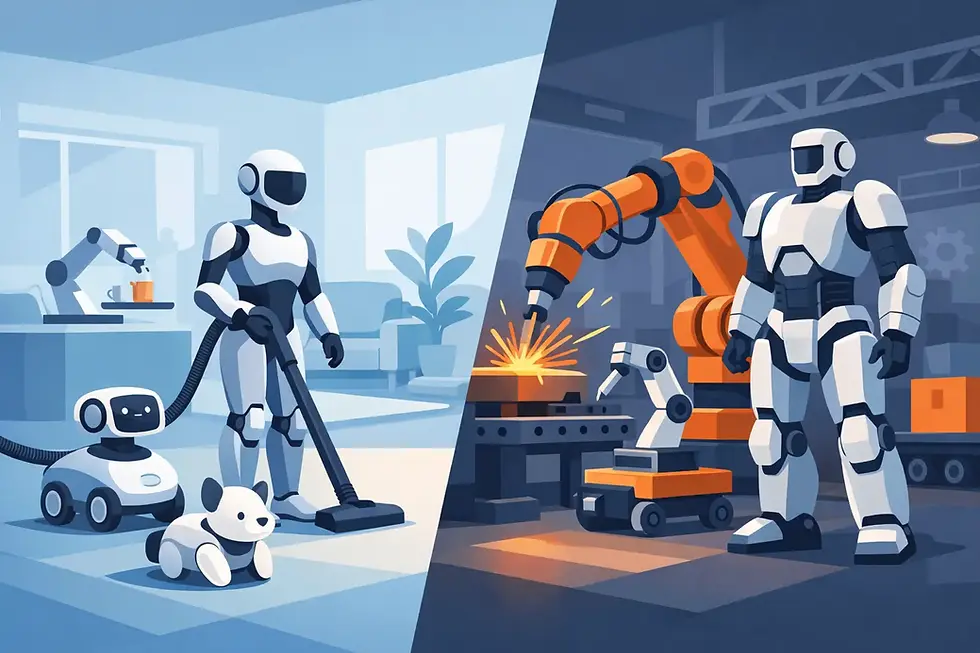
Before comparing specs, define what success looks like. A humanoid meant to move totes on a warehouse floor should not be judged by the same criteria as one designed to greet hotel guests or help researchers develop AI behaviors. The form may look similar, but the engineering priorities can be radically different.
Get specific about the environment. Is the robot operating indoors on flat floors, on a busy factory line, or outdoors where weather and uneven ground enter the equation? Will it handle objects, navigate around people, talk to customers, or perform a single repetitive motion? Is a human operator nearby, or does the robot need to work with limited supervision?
This matters because “general purpose” is still an ambition more than a universal product category. A machine that excels at one tightly controlled workflow may be the smarter purchase than a more theatrical humanoid that has not yet proven itself outside a demo setting.
How to Compare Humanoid Robots by Physical Ability
Humanoid robots live or fail by the relationship between their body, balance, hands, sensors, and control software. A specification sheet can look futuristic, but it needs context.
Mobility is more than walking speed
Walking is visually dramatic, which is why it dominates so many robot videos. Yet a fast gait tells you little about whether a robot can stop accurately, turn in a narrow aisle, recover from a bump, step over a threshold, or operate for hours without falling.
Look for details about degrees of freedom, joint range, top speed, stair capability, payload while walking, and recovery behavior. Also ask whether it needs a mapped environment, a safety tether, or a carefully prepared floor. A wheeled humanoid may be less cinematic than a biped, but it can be faster, cheaper, and more stable for many indoor tasks.
The key trade-off is simple: legs offer access to spaces designed for people, while wheels often offer better endurance and lower operational complexity. Neither is automatically superior.
Hands reveal the real task ceiling
Human-shaped hands are not automatically useful hands. The meaningful questions are grip strength, finger dexterity, tactile sensing, wrist range, repeatability, and the types of objects the robot can manipulate.
Can it pick a rigid box, a soft garment, a clear plastic bottle, a tool, and an item placed at an awkward angle? Can it use both hands together? Can it open a door, place something gently, and recover when an object slips?
Many commercial tasks do not require five-finger human imitation. A specialized gripper can outperform a dexterous hand when the workflow is known. If the task changes frequently, however, adaptable hands and tool use become far more valuable.
Payload needs a full story
A payload number is only the beginning. Find out where the weight is carried, how long it can be carried, whether the robot can lift from floor level, and whether the figure applies while walking, reaching, or using both arms. A humanoid that handles a heavy load briefly in a controlled test may not be ready to repeat that motion for an entire shift.
Judge Intelligence Through Repeatable Work
The real magic of a humanoid is not just the body. It is the system’s ability to perceive a changing scene, choose an action, and complete it without constant human correction.
Ask how the robot sees. Cameras, depth sensors, lidar, force sensors, tactile sensors, and microphones each solve different parts of the problem. More sensors are not always better, but the robot must have enough perception for its intended setting. A warehouse picker needs dependable object recognition and spatial awareness. A companion robot needs strong speech interaction, face or person awareness, and behavior that feels responsive rather than scripted.
Then separate autonomy from teleoperation. Remote human control is not a weakness during early deployment. In fact, it can be a practical bridge to real work while the robot learns. But a vendor should be clear about which actions are autonomous, which require supervision, and how often an operator intervenes.
A serious demo shows variation. Watch the robot handle different object positions, changing lighting, people walking nearby, and small mistakes. One perfect run is exciting. Fifty reliable runs are commercially meaningful.
Measure Safety Like It Is a Feature, Because It Is
Humanoids are powerful, mobile machines built to work around humans. Safety is not paperwork added after the exciting part. It is part of the product.
Evaluate the robot’s speed limits near people, collision detection, force control, emergency-stop design, remote shutdown, fall behavior, and operating-zone requirements. Ask what happens if a camera is blocked, connectivity drops, a battery gets low, or a person unexpectedly crosses its path.
Also consider the practical side of deployment. Does the company provide site assessment, training, risk guidance, and ongoing monitoring? A robot can have extraordinary hardware and still be difficult to introduce responsibly into a real workplace.
For buyers, the best safety question is not “Is this safe?” It is “Under what conditions is this safe, and what safeguards are required?” Specific answers signal a company that understands deployment rather than just prototypes.
Compare the Economics Beyond the Sticker Price
Humanoid robotics is entering a phase where headline pricing can be misleading. Some robots are sold as hardware, some are leased, some are offered through pilot programs, and some remain limited to strategic partners. The acquisition cost matters, but it is only one line in the equation.
Factor in installation, charging infrastructure, spare parts, software subscriptions, maintenance, operator training, insurance, integration, and human oversight. A lower-cost robot that needs frequent intervention may cost more over time than a higher-priced platform with strong fleet management and service support.
Battery performance deserves its own scrutiny. Look at useful work time, not just battery capacity. How long does the robot run under a realistic load? How long does it take to charge? Can batteries be swapped? Does performance degrade as charge drops? The answer determines whether the robot fits a short demonstration, a single shift, or a round-the-clock operation.
Look at the Company Behind the Machine
Buying or piloting a humanoid is also a bet on a robotics company. Hardware will evolve, software will update, and your needs will change. You need to know who will be there after delivery day.
Assess the company’s manufacturing direction, funding runway, deployment history, software update process, support model, and developer tools. A startup can be an outstanding choice when it offers a sharp solution to a narrow problem and close access to its engineering team. A larger company may bring more support capacity and a clearer path to scaling. It depends on your risk tolerance and timeline.
Ask whether the platform is open to integrations. Can it connect with warehouse systems, facility controls, business software, or custom AI models? Can your team access logs and performance data? A humanoid that cannot fit into the rest of your operation may become an impressive standalone attraction rather than a productive teammate.
Build a Comparison Scorecard That Resists Hype
The clearest way to compare contenders is to score them against the same mission. Weight the categories based on what matters most to your project. For a warehouse deployment, reliability, payload, uptime, and safety may outweigh conversational ability. For a public-facing robot, interaction quality and visual presence may deserve a larger share.
Use these five categories as a practical starting point:
Task performance: Can it complete the exact job accurately and repeatedly?
Operating fit: Does it work in your space, around your people, and within your workflow?
Autonomy and oversight: How much human help does it need to stay productive?
Total operating cost: What does the machine cost to deploy, run, maintain, and scale?
Vendor readiness: Can the company support a pilot and grow with your use case?
Score what you have actually seen, not what a roadmap promises. Give extra credit to demonstrations performed in conditions that resemble your own. If possible, provide a test object, a task sequence, or a realistic layout and see how the robot responds.
This is where a focused discovery platform such as We Are The Robots can be useful: it helps you see the market as a living ecosystem of machines, companies, demonstrations, and ideas rather than a single viral clip.
The Most Useful Question to Ask at a Demo
When the lights are on and a humanoid is moving with uncanny confidence, ask one question: “What breaks first when this leaves the lab?”
The answer may be battery duration, edge-case perception, hand reliability, network dependence, operating speed, or the need for human assistance. That is not necessarily a dealbreaker. Every robot has limits, including the most advanced systems on the planet. What matters is whether those limits are understood, honestly communicated, and compatible with your intended use.
The future of smart machines will not arrive as one perfect humanoid that does everything. It will arrive through capable robots doing more real work, in more real places, one proven task at a time. Compare with curiosity, demand evidence, and choose the machine that makes your next practical experiment possible.


Comments