
Humanoid Robot Features Guide for Smart Buyers
- Or Alkalay
- Jul 25
- 6 min read

A humanoid robot can wave, walk, carry a tote, answer a question, and still be a long way from being useful in your home or workplace. That gap is exactly why a humanoid robot features guide matters. The most impressive robot is not always the one with the flashiest demo. It is the machine whose sensors, hands, software, power system, and safety controls match the job you actually imagine it doing.
Humanoids are moving out of research labs and onto factory floors, conference stages, warehouses, and product roadmaps. Tesla Optimus, Figure, Unitree, Boston Dynamics, and a fast-growing field of global challengers are all pushing the category forward. The future of smart machines is no longer a vague promise. But smart buyers should look beyond the highlight reel.
Humanoid Robot Features Guide: What to Evaluate First
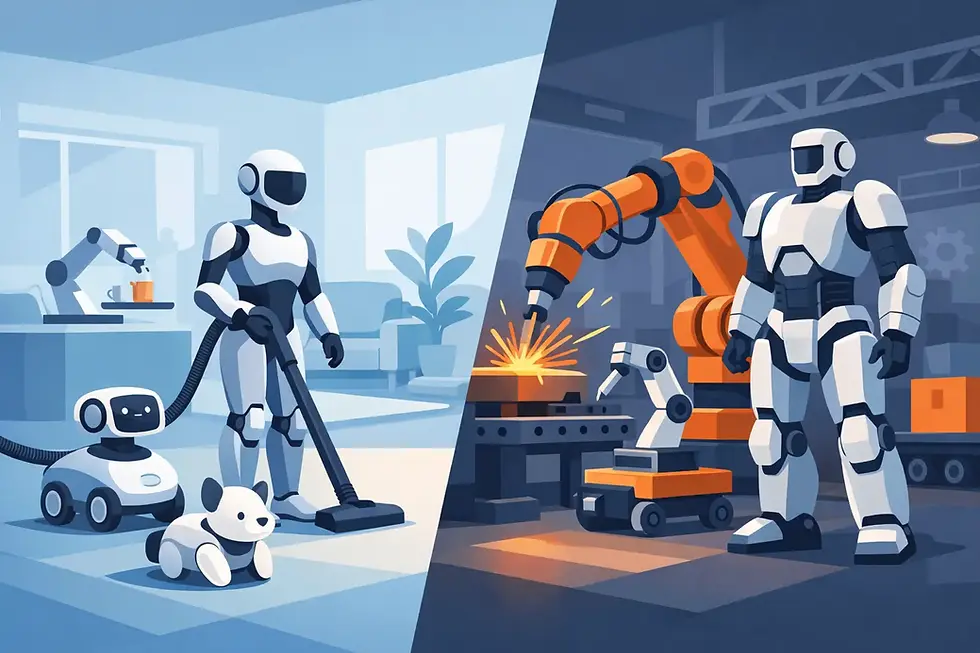
Start with the environment. A robot built to move bins through a structured warehouse has different priorities than one designed for home assistance, retail greetings, or research. Human shape is valuable because our world was built around human dimensions: stairs, shelves, doors, tools, worktables, and storage racks. Yet legs, arms, and hands make a robot far more complex than a wheeled machine.
The first question is not, "Does it look human?" Ask, "Can it repeat a useful task safely, at a useful speed, in my space?" That single shift separates a futuristic concept from a serious platform.
Mobility is more than walking
Bipedal walking gets the attention because it looks incredible. It also lets a robot navigate spaces that wheels cannot easily handle, including narrow aisles, uneven transitions, and human-designed work areas. But walking consumes energy, adds mechanical complexity, and introduces balance risks. For many tasks, a wheeled humanoid or a robot with a stable rolling base may be the better business decision.
Look at gait stability, recovery from a push or slip, turning radius, floor requirements, and speed while carrying an object. A robot that walks elegantly with empty hands may slow down dramatically once it is holding a box. Stairs are another headline feature, but they matter only if your facility or home truly requires them.
Also pay attention to the robot's height and reach. A compact humanoid may fit better around people and furniture, while a taller platform can access standard shelves and counters. Neither is automatically better. The right dimensions depend on the task zone.
Hands reveal the real ambition
Arms get a robot to the object. Hands determine what happens next. A basic gripper can handle repeatable picks, totes, and standardized parts with impressive reliability. A multi-finger robotic hand has the potential to manipulate tools, open packaging, sort irregular objects, and perform more human-like work.
More fingers do not automatically mean more capability today. Advanced hands require sophisticated sensing, control, and training data. They can be slower, more delicate, and more expensive to maintain than a purpose-built gripper. When comparing humanoids, ask what objects the hands can grasp, how much payload they support, whether they can detect contact or force, and how often the task succeeds without human intervention.
The exciting benchmark is not simply a robot picking up an apple. It is a robot handling hundreds of varied objects, placing them accurately, and recovering when an item shifts, drops, or arrives in the wrong orientation.
Vision, sensors, and AI create awareness
A humanoid needs to understand where it is, what is around it, and what it is touching. Cameras, depth sensors, inertial measurement units, joint encoders, microphones, and force sensors work together to build that awareness. This sensor stack is the difference between a machine following a tightly scripted route and one that can adapt to a changing scene.
AI is often described as if it were one feature. In reality, there are layers. Computer vision helps identify people, objects, labels, and obstacles. Motion planning determines how the body moves without collisions. Language models can make voice interaction feel natural. Learning systems may improve task performance from demonstrations or operational data.
That does not mean every robot with a conversational voice can independently perform household chores. Voice is an interface. Autonomy is earned through perception, planning, dexterity, and extensive real-world testing. Ask whether the robot operates independently, follows remote operator guidance, or uses a hybrid model. Human-in-the-loop support is not a failure. For early deployments, it is often the practical path to better reliability.
The Features That Decide Daily Use
A robot's demo can last two minutes. A deployment needs to survive an entire shift. That makes power, maintenance, connectivity, and safety just as important as a dramatic walking video.
Battery runtime should be considered alongside charging time, battery-swapping capability, and the type of work being performed. Fast movement, heavy lifting, and active computing all drain power. A listed runtime may reflect light operation rather than continuous production work. For commercial use, the real metric is productive hours per day, including downtime for charging, inspection, and updates.
Safety is equally non-negotiable. Humanoids have moving limbs, meaningful mass, and sometimes high-torque joints. Look for emergency stop access, speed limits near people, collision detection, force limiting, safe operating zones, and clear procedures for failures. A robot intended to work around employees, customers, children, or pets needs a safety strategy that is visible, tested, and easy to understand.
Maintenance deserves a closer look than it usually gets. Can operators replace a battery, hand module, or cover panel? How are software updates delivered? Is remote diagnostics available? What support exists when a robot stops in the middle of a task? The glamorous purchase price is only one part of the ownership equation.
Payload, precision, and repeatability
Payload tells you how much a robot can lift, but it does not tell the full story. A robot may lift a heavy object close to its body but struggle with that same object at arm's length, while walking, or when placing it onto a high shelf. Ask for task-specific payload figures whenever possible.
Precision matters when a robot loads a machine, uses a tool, plugs in a cable, or handles delicate inventory. Repeatability matters when it must do that task hundreds of times. For a warehouse or manufacturing team, a slightly slower robot that succeeds consistently can be far more valuable than a faster machine requiring frequent rescues.
Personality has a place too
Not every humanoid is headed for industrial work. Companion-focused robots, reception robots, educational platforms, and public-facing machines benefit from expressive movement, a recognizable voice, eye displays, gestures, and social awareness. These features can make technology feel less intimidating and more engaging.
Still, personality must serve the experience. A retail guide should give accurate directions. An educational robot should encourage curiosity without creating confusion. A home companion should be transparent about privacy, recordings, and cloud services. Friendly design earns trust only when the system behaves responsibly.
How to Compare Robots Without Getting Lost in Specs
Product specifications are useful, but demonstrations tell a deeper story. Watch for the details that manufacturers may not put in a comparison table: Does the robot move confidently in a messy environment? Does it hesitate before a grasp? What happens when it misses? Is a human operator nearby? Does the video show a single polished success or a repeatable workflow?
When evaluating a platform, keep four questions in view:
What exact task can it perform now, not someday?
What environment does it require to perform that task well?
How much human supervision, setup, and maintenance does it need?
What is the path from a pilot project to dependable daily operation?
For creators and early adopters, the answer may be excitement, experimentation, and first-mover access. For a business, the answer should connect to throughput, labor support, safety, customer experience, or data collection. Both are valid reasons to follow this market. They simply lead to different buying decisions.
At We Are The Robots, the most compelling machines are not just the ones that look like they stepped off a movie set. They are the ones that show where the category is heading while giving us a believable glimpse of what can be done next.
The humanoid revolution will not arrive as one perfect robot that does everything. It will arrive task by task, feature by feature, in machines that become more capable every time they see, grasp, walk, learn, and work alongside us. Watch the demos closely, ask sharper questions, and imagine what could be done when the right robot meets the right job.


Comments